Artist Statement

Balancing Art, Work and Life!

Welcome to Your Artist Statement!
August16

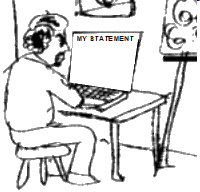
“@#$%*! I’m an artist, not a writer!”

The art world these days is not what it used to be. Galleries these days require artist statements from all their exhibitors, to give a quick picture to buyers of what the artist is all about. Most artist’s first reaction is like that of our friend to the left. “How can I summarize in a few words what my art is all about? It’s from deep within me; I’m not sure I know myself where it comes from or what it means! Anyway, what business it it of theirs? My art should speak for itself!”

Cultivating CollectorsBut as far as the world of art business is concerned, it doesn’t. Gallery owners and agents need a short statement which will distinguish your work from others, without actually showing it. So like it or not, if you want to sell your art in today’s market, you need an artist statement. The news is not all bad. The statement is not only a tool for business, but can be a valuable aid in your own work. It requires that you examine yourself and your work deeply, in order to find out where you are coming from. This can be scary, but in the end such a self analysis can be a useful tool in knowing yourself, and some might say that is what real art is all about.

But how to begin? This site is your answer. Select from a wide variety of articles in the menu at right, or check out articles in the following categories:

Writing The Artist Statement | The Business Of Art | The Creative Life

They will help you not only create your Statement, but also make your way in today’s art world, and balance your creative self with the necessities of the (gulp) business of art.

This site is evolving. Please let us know what else you would like to see on these pages. Drop me a line at theartist@artiststatement.com and may the spirit of creativity be always with you!

/glen cram

The Online Self Improvement and Self Help Encyclopedia

posted under Assorted

Comments are closed.

Comments are closed.


Feature Article

Artist Statement Do's and Don'ts

By Alyson Stanfield
ArtBiz Blog

An artist statement is a necessary component of any professional artists' portfolio or promotional packet.

When writing your artist statement, DO:

* Write in the first person. It is a statement, after all.

* Be brief, 2-3 paragraphs at most. Always err on the side of brevity. You can write more, but why would you want to? People have short attention spans these days. Load as much punch into the delivery as you can. Combine sentences and delete ones that aren't vital. As Henri Matisse said in his treatise on painting, "All that is not useful to the picture is detrimental." The same could be said of your statement.

* Describe the current direction of your work and your approach, particularly what is unique about your methods and materials.

* Sit on it for a few days and come back to it with a fresh mindset. Most artists, in my opinion, hate their statements because they rushed them in preparation for an exhibit and didn't care to spend any more time on them. How do you expect it to be any good if you don't work at it?

* Consider more than one statement if you are trying to discuss more than one body of work. If you try to get too much into a single statement, you run the risk of saying nothing and trying to be everything to all people. This is bad marketing/bad promotions.

* Allow your artist statement to grow, change, and mature along with your work. Don't let it sit on a shelf and collect dust. It should be organic and you shouldn't be afraid to change it and make it better.

* Make sure your statement passes the litmus test. Above all, viewers should be compelled to put the statement away and look back at the work. Your statement isn't successful if people read the words on the page, and then put them down and go on to the next artist.

When writing your artist statement, DO NOT:

* Use too many personal pronouns. Yes, I said to write in first person, but try to severely limit the number of "I"s, "me"s and "my"s that are used. You'll be amazed at how many other ways there are to phrase things. You want people to relate to your words and to your art. Too many personal pronouns will put up an unnecessary a barrier.

* Tell your life story. You can keep that for your bio (as long as it's interesting). Your artist statement is only about the current direction of your work.

* Quote or refer to anyone else by name. Keep the focus on you and your art. Mentioning another name shifts the readers' attention from your art to the other person.

* Forget to use spell check and ask someone else to read it over for you.

View the time to write your artist statement as an opportunity to clarify your thoughts. A well-written statement, approached deliberately and thoughtfully, can be a boon to your self-promotion efforts. You'll use the language on your Web site and in grant applications, press releases, brochures, and much more.

© Alyson Stanfield, All rights reserved.

Alyson B. Stanfield is an art-marketing consultant, artist advocate, and author of I'd Rather Be in the Studio! The Artist's No-Excuse Guide to Self-Promotion. Sign up for her free Art Marketing Action newsletter at